



Léa Meziane: From Dauphine London to Best-Selling Author

From Dauphine London to Best-Selling Author: Léa Meziane on Careers, Creativity, and Following Your Passion
By Juliette Thenot, Dauphine London student
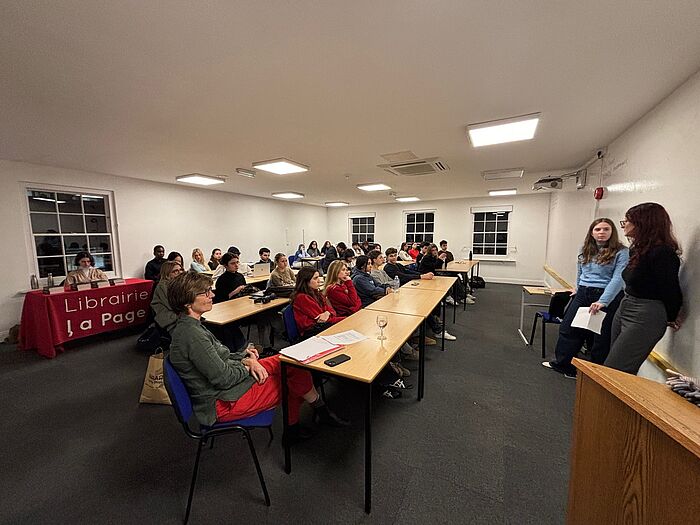
On the Dauphine London campus, we had the honour of welcoming Léa Meziane, an alumna of Dauphine London, who returned to share her inspiring journey with current students.
Léa studied at the London campus for two years before specialising in Management during her third year. After earning her bachelor’s degree, she chose not to pursue a Master’s immediately. Instead, she decided to take a gap year, a decision that would profoundly shape her professional and personal path.
Her journey is atypical in the best sense of the word. Unsure which field she truly wanted to pursue, Léa preferred gaining professional experience rather than committing to a Master’s program that did not fully resonate with her aspirations. She joined the consulting firm Gartner, where she worked for a year and a half. Alongside her professional career, she continued writing, a passion she had developed during her time at Dauphine. In January 2025, she published her novel Insomnia. Just two months later, she left Gartner to dedicate herself entirely to writing. Now a self-made author, she has written the best-selling novel Insomnia, while still planning to return to university to pursue a Master’s degree.
Her novel Insomnia tells the story of Skyler, a young woman beginning her studies at the prestigious University of Oxford. Hoping to escape a threatening family past and start anew, Skyler soon discovers that the campus conceals far more than it reveals. Everything changes after a nocturnal encounter with a mysterious man wearing a skull mask, who draws her into a hidden world governed by secret societies, power, and opulence. From the moment Skyler meets the icy blue gaze of this enigmatic student, there is no turning back. As secrets unravel, she must confront truths that could shatter everything she thought she knew. The novel embraces a dark academia atmosphere, blending mystery, ambition, and psychological tension.
During her visit, Léa spoke with Juliette about her time at Dauphine, her consulting experience, and the unexpected success of her novel Insomnia.
Can you tell us about your time studying on the Dauphine London campus?
I remember my time at Dauphine London with great enthusiasm. One of the main reasons I chose the London campus was my deep love for the city itself. London’s cultural richness, diversity, and constant energy immediately appealed to me. For me, studying in London meant living in a vibrant, international environment where creativity and ambition coexist.
I was also particularly drawn to the pluridisciplinary nature of the program. The combination of economics, management, and social sciences offered a broad intellectual foundation while keeping multiple career paths open. This interdisciplinary approach allowed me to explore different interests without feeling confined to a single track, which was important because I was still unsure about my future at the time.
“Studying in London meant living in a vibrant, international environment where creativity and ambition coexist.”
Finally, the atmosphere of a small campus played a decisive role in my experience. Unlike large universities where students can sometimes feel anonymous, Dauphine London offered a close-knit academic community. Smaller class sizes meant we could build strong relationships with professors and other students, which encouraged discussion, participation, and personalised guidance. This supportive environment really helped me grow both academically and personally.
Why did you decide to take a gap year after your bachelor’s degree?
Taking a gap year was a very important decision for me. At the end of my bachelor’s degree, I felt uncertain about my future. Many of my friends were determined to pursue careers in finance or immediately enroll in Master’s programs, but I didn’t feel fully aligned with the options that were available to me at the time.
Rather than entering a theoretical program without being convinced, I decided to confront the professional world directly. A gap year can be incredibly valuable for students who feel unsure because it allows you to test different environments, understand your preferences, and gain clarity through experience. In the UK, entering the workforce after a bachelor’s degree is quite common, so I decided to follow this path by joining Gartner.
What did your experience at Gartner teach you about the professional world and about yourself?
At Gartner, I worked in consulting, speaking with clients to understand their key priorities and challenges. I then wrote reports and collaborated with internal experts to develop solutions. Professionally, the experience helped me develop resilience, learn how to manage stress, and become more confident in public speaking. I presented projects almost every day to high-level executives, which really strengthened my ability to communicate clearly and persuasively. At the same time, the experience taught me a lot about myself. It helped me understand what I enjoy in a professional environment and what doesn’t suit me as well.
“My time at Gartner helped me realise that I needed creativity and freedom in my work.”
When did you realise that corporate life was not fully aligned with your aspirations?
Over time, I began to notice the rigidity that can exist in large corporations. As someone who is quite creative and imaginative, I sometimes found the hierarchical structure and limited autonomy restrictive. Starting in an entry-level position meant following instructions rather than initiating projects independently. While I appreciated the learning experience and everything it taught me, I realised that corporate life did not fully align with my need for creativity and freedom. This realisation wasn’t negative; it was actually very clarifying. My time at Gartner helped me understand the type of professional environment in which I could truly thrive.
When and how did you start writing Insomnia?
I started writing Insomnia during my time at Dauphine. At first, I published chapters on Wattpad simply as a passion project. Writing was something I loved doing in my spare time. It actually took me about three years to complete the novel. As the story gained traction online, it began attracting attention and eventually caught the interest of several publishing houses.
“I started writing Insomnia during my time at Dauphine as a simple passion project.”
Why did you choose Oxford as the setting for your novel?
Choosing Oxford was very intentional. During my studies in London, I had the opportunity to visit Oxford several times, and I was completely captivated by it. The architecture, the history, and the atmosphere all felt almost magical. I had always dreamed of studying there myself, and through my novel, I was able to recreate that world. The dark academia aesthetic of Oxford—with its ancient libraries, secretive traditions, and intellectual intensity—felt like the perfect setting for Insomnia.
How did your studies in economics and management help you when working with publishers?
My background in economics and management turned out to be extremely useful when I started negotiating with publishers. My studies gave me analytical and communication skills that helped me confidently discuss contracts and negotiate profit percentages. Understanding business language and strategy allowed me to defend my interests and make informed decisions. It really showed me that the skills I learned at Dauphine go far beyond the classroom and can be applied in very different industries.
“The skills I learned at Dauphine helped me negotiate confidently and make informed decisions with publishers.”
How did you experience the success of the novel and its visibility on social media?
The success of the novel was both exciting and overwhelming. During the first two months after its release, I felt quite stressed because the visibility grew very quickly, especially on platforms like TikTok and Instagram. Because Insomnia began as a passion project, seeing it reach a national audience felt surreal. Attending book signings and meeting readers made the experience much more real. Many young readers shared how much the story meant to them, and some even brought gifts or personal messages. It was strange at first to realise that something I had written in my room was now being read across the country, but I feel incredibly grateful for the support I’ve received.
What made you decide to leave Gartner and focus entirely on writing?
At first, I never imagined writing would become my full-time profession. I always saw it as a competitive and uncertain field. However, the unexpected success of Insomnia changed things. Financially, the novel ended up being more rewarding than my corporate position, but more importantly, writing offered the creative freedom and independence that I was looking for. That said, I always encourage aspiring writers to have a safety net because the publishing world can be unpredictable.
What are your plans for returning to university and continuing your studies?
Looking ahead, I plan to pursue a Master’s degree in Entertainment and Cinema in the UK. I’d like to continue developing my creative interests while also building on my academic background.
What advice would you give to current Dauphine students?
One piece of advice I would give is to consider the flexibility of the UK academic system. Many of my friends pursued Master’s degrees at universities such as LSE, Imperial, or King’s College. One advantage is that many UK Master’s programs can be completed in just one year. More importantly, I would encourage students to nurture their creative passions. Hobbies shouldn’t be neglected; they should be part of your daily life. As responsibilities grow, it becomes harder to make time for them. For me, writing started as a simple passion, and it eventually became a career. My journey shows that personal interests can sometimes lead to unexpected and fulfilling paths.
Published on 22 March 2026
- 07/02/2026Dauphine London Open Day 2026
